
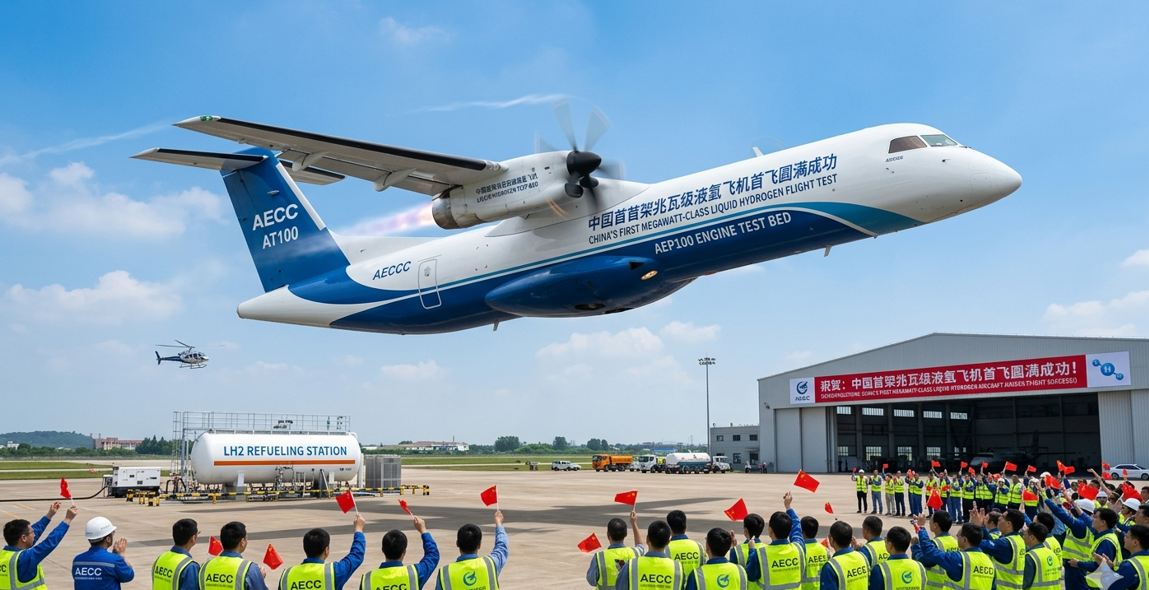
- Liquid hydrogen is preferred over gaseous hydrogen because it offers higher energy density, allowing for the "space-efficient" storage necessary for long-range flight.
- The primary obstacle remains the boil-off and the specialized, heavy insulated tanks required to keep fuel at –253°C.
- The immediate application is unmanned regional cargo. As the technology matures and infrastructure (hydrogen hubs) scales, the goal is to transition this megawatt-class power to manned regional passenger aircraft.
China has achieved a significant milestone in "green aviation" with the successful maiden flight of a megawatt-class liquid hydrogen-fueled engine on April 4, 2026. Conducted at Zhuzhou Lusong Airport in Hunan province, the test involved a 7.5-metric ton unmanned cargo aircraft that completed a 16-minute stable flight over a distance of 36 kilometers. Developed by the Aero Engine Corporation of China (AECC), the AEP100 engine marks a transition from laboratory theory to practical engineering, utilizing direct hydrogen combustion rather than traditional fuel cells. This technology allows the engine to function similarly to a standard turboprop but with zero carbon dioxide emissions, as the primary byproduct is water vapor.
The success of this flight puts China in a select group of global leaders, alongside companies like Airbus and Rolls-Royce, who are racing to decarbonize the aerospace sector. By utilizing liquid hydrogen ($LH_2$) stored at cryogenic temperatures near $-253$°C, the propulsion system offers a pathway toward energy security and the development of a massive industrial chain involving green hydrogen production and specialized storage materials. While the test proved the engine's reliability at a cruise speed of 220 km/h and an altitude of 300 meters, significant hurdles remain. Engineers must still address the challenges of hydrogen's low volumetric energy density, which requires bulky insulation, as well as the need for a global hydrogen refueling infrastructure before the technology can scale from unmanned logistics to commercial passenger travel.



Facebook Comments