
Airline ticket prices are determined by dynamic revenue management, where hidden fare buckets, booking timing, seat availability, passenger demand, and traveler behavior—not the seat itself—dictate how much each passenger pays.
Have you ever settled into an Economy seat and wondered why the person sitting next to you paid half—or double—what you did for the exact same flight? To most of us, an Economy cabin is just a room full of identical seats. But to an airline’s revenue management system, an airplane is a dynamic marketplace where every single seat carries an invisible, constantly shifting price tag.
The primary driver behind this price variation is a strategy called dynamic yield management. Airlines treat airplane seats like perishable goods: once the cabin door closes and the aircraft takes off, an unsold seat loses 100% of its value forever. To maximize revenue on every flight, airlines do not list all seats at one flat rate. Instead, they divide the cabin into hidden sub-categories known as Reservation Booking Designators (RBDs) or "fare buckets."
Consider Nepal Airlines Flight RA433, a direct flight from Kathmandu (KTM) to Tokyo Narita (NRT) operated on an Airbus A330. Nepal Airlines does not sell all 256 Economy seats at a single price tag. Instead, the system assigns seats across various RBD codes (such as 'L', 'M', or 'Y'). The cheapest bucket ('L') might contain 30 seats set at NPR 65,000. Once students or early planners buy out those 30 tickets, that lower price vanishes automatically, and the system rolls over to mid-tier buckets ('M') at NPR 85,000, eventually scaling up to top-tier buckets ('Y') at NPR 120,000 for the final remaining seats.
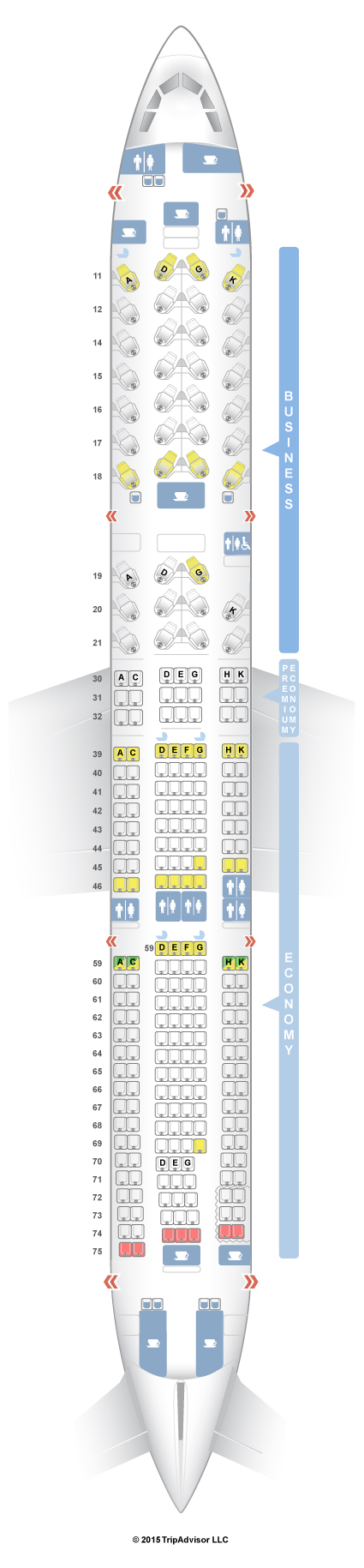
This raises a common question: what happens on airlines where all Economy RBDs carry zero change penalties, zero refund fees, and identical baggage rules? Even when the ticket conditions and onboard services are 100% identical, dramatic price gaps remain because you are not paying for extra perks—you are paying for time, guaranteed availability, and passenger segmentation.
Airlines use fare buckets to separate two distinct types of buyers on the same route:
- Early Leisure Travelers: A Nepali student traveling to Japan for their university semester plans months in advance. Because they book early when low-tier RBDs are open, they grab the NPR 75,000 seat.
- Last-Minute Travelers: A business executive or someone flying urgently for a family emergency needs to book just three days before departure. Because this passenger must be on that specific direct flight, the airline holds the final 15% and above of seats strictly in top-tier RBDs priced at NPR 128,000.
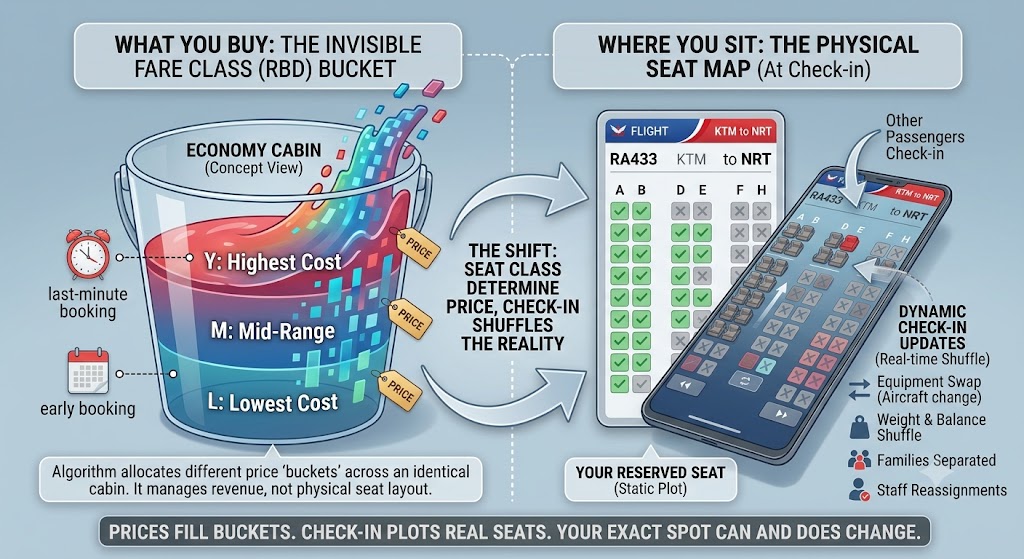
Finally, overall market demand dictates which price buckets are unlocked. During high-demand travel windows—such as Dashain, Tihar, or Japan’s spring Sakura season—demand for direct flights out of Kathmandu skyrockets. To capture maximum revenue when thousands of travellers are competing for limited direct seats, Nepal Airlines simply shuts down the cheap fare buckets entirely. Even a traveller searching two months early for a peak holiday date will only see high-tier fare buckets available.
In short, whether on a regional hop or a long-haul journey to Tokyo, your ticket price is never just a reflection of the physical cushion under you. You are paying for when you booked, how many seats remained on the aircraft, and how urgently you needed to fly.



Facebook Comments