
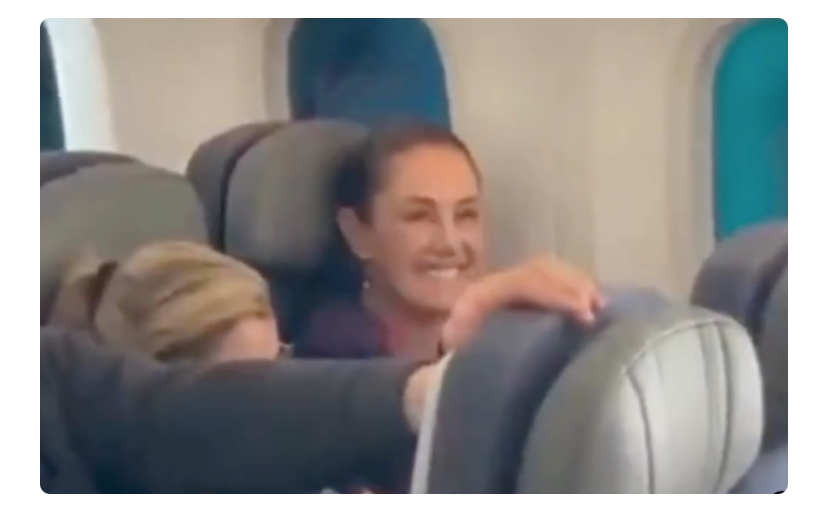
Mexican President Claudia Sheinbaum has once again drawn attention within the aviation sector after being observed traveling on a long-haul commercial flight in economy class during her recent visit to Barcelona.
According to reports, the head of state boarded a scheduled commercial service rather than utilizing a dedicated government or chartered aircraft, continuing a pattern that has become a defining characteristic of her administration’s travel policy. The latest sighting reportedly occurred on a transatlantic sector linking Spain with Mexico, with indications that the aircraft involved was a widebody long-haul type, such as the Boeing 787 commonly deployed on intercontinental routes.
Passengers onboard documented the unusual presence of a sitting president in a standard economy cabin, where Sheinbaum was seen occupying a regular seat and interacting informally with cabin crew and fellow travelers. The lack of a premium cabin arrangement or dedicated VIP configuration highlights a significant departure from traditional presidential air travel norms, where heads of state typically operate via government-owned aircraft or premium-class commercial cabins.
This is not an isolated case. Since taking office in 2024, Sheinbaum has repeatedly opted for commercial aviation in economy class for international missions, including previous trips to global summits. The approach reflects a broader political philosophy aligned with austerity and cost-efficiency, a stance that also echoes policies introduced by her predecessor, who notably divested Mexico’s presidential aircraft.
From an aviation operations perspective, such travel decisions introduce unique logistical and security considerations. Unlike state aircraft operations—which typically involve controlled flight schedules, dedicated security protocols, and restricted passenger environments—commercial flights require coordination with airline operators, airport authorities, and security agencies to ensure both passenger safety and minimal disruption to regular service.
Sheinbaum’s journey to Barcelona was linked to her participation in high-level international engagements, including a multilateral summit aimed at strengthening diplomatic cooperation and political dialogue between Latin American and European leaders.
The continued use of economy-class commercial travel by a G20 nation leader remains rare in modern aviation and political practice, positioning Sheinbaum as an outlier in executive air transport trends. For the airline industry, such instances generate significant public attention, often translating into increased brand visibility for the operating carrier, while also raising discussions حول cost governance, sustainability, and the evolving optics of official travel in the post-pandemic era.


Facebook Comments