
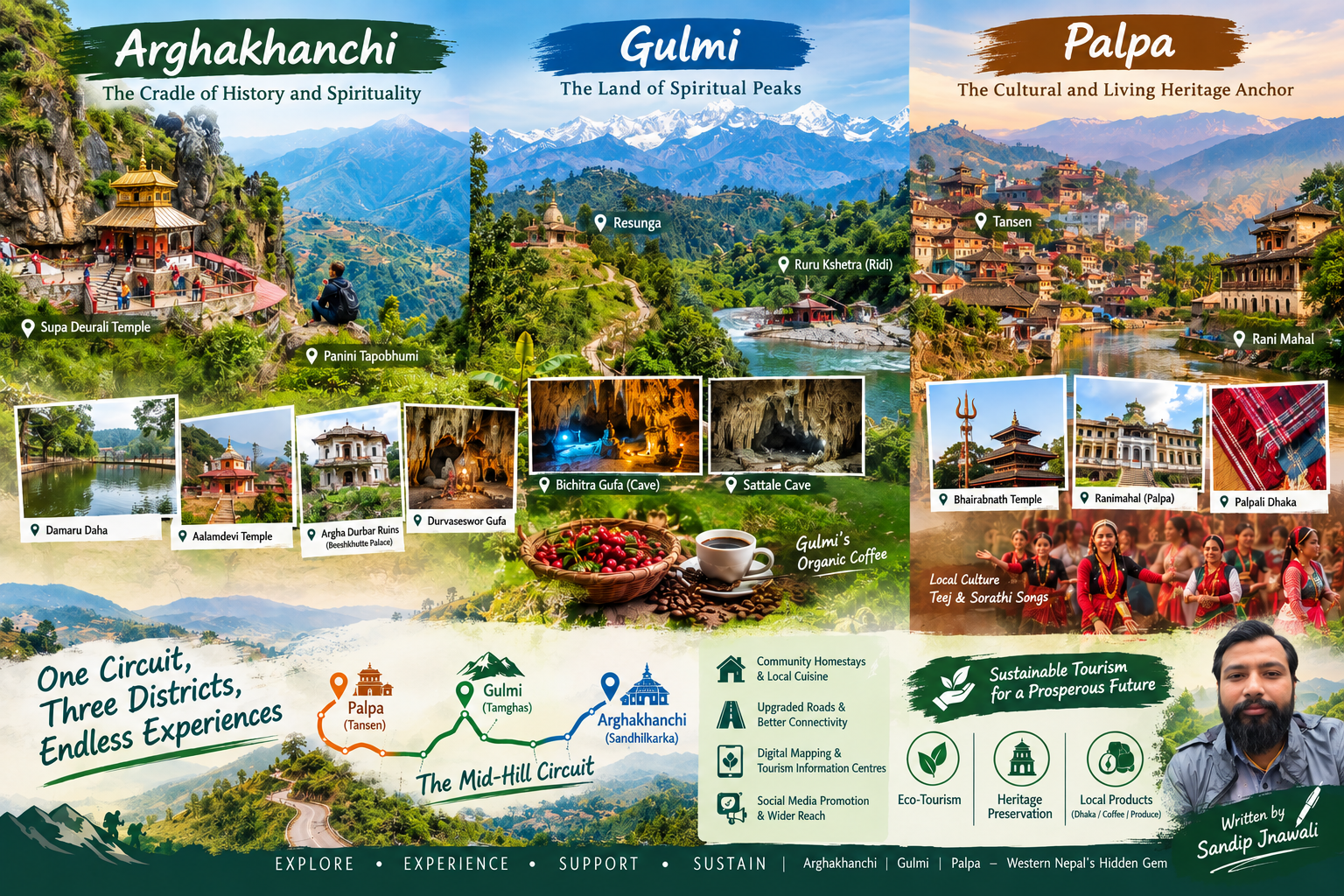
Hidden in the green hills of Nepal’s Lumbini Province, Arghakhanchi, Gulmi, and Palpa are great, undiscovered places that have huge potential for tourism. Individually, each district boasts distinct historical, religious, and natural treasures, but when combined, they form a perfect, continuous eco-cultural hill circuit capable of drawing thousands of domestic and international travelers away from overcrowded hotspots like Pokhara and Chitwan. Developing sustainable tourism across these three districts requires a strategic mix of infrastructure upgrades, community-led initiatives, and cross-district marketing. To develop this tourism systematically, we must first understand the primary anchor attractions each district brings to the table.
Arghakhanchi: The Cradle of History and Spirituality
Arghakhanchi is a quiet, hilly place perfect for relaxing and exploring history. The district is a massive hub for religious tourism primarily due to the legendary Supa Deurali Temple, which is Tucked dramatically between massive cleft hills and draws nearly a million domestic and Indian pilgrims annually. Deepening its spiritual attraction is Panini Tapobhumi where the famous ancient scholar Sage Panini meditated. According to local legends, he performed strict penance here and received divine blessings from Lord Shiva, which inspired him to write the world's first formal rules of Sanskrit grammar. Located at an altitude of 1,463 meters, this peaceful destination offers visitors stunning panoramic views of the green mountains alongside a deep connection to ancient history, making it a perfect spot for spiritual travellers and history lovers. Damaru Daha According to Hindu legends, the lake is deeply connected to Sage Panini's meditation, as it marks the spot where Lord Shiva played his Damaru (drum) to create the sounds of Sanskrit grammar. Today, the local government has beautifully developed the area with neat walkways and parks, making this quiet, tree-surrounded lake a highly popular destination for peaceful sightseeing, photography, and spiritual walks and the revered Aalamdevi Temple. For history enthusiasts, the ruins of Argha Durbar tell stories of the ancient principalities that existed before Nepal's unification. Most notably, the district boasts the historic town of Mathura, the birthplace of the founder of the Rana dynasty, Jung Bahadur Rana, where travellers can explore the recently restored Beeshkhutte (Lampati) Palace.Durvaseswor Gufa (often spelled Durvaseswar or Durbasha Cave) is a fascinating, hidden religious and historical gem located in Arghakhanchi district, in western Nepal. Specifically, it is situated in Durgafat, Panini Rural Municipality (formerly Khidim). According to the Himavat Khanda of the Puranas, this cave is the ancient tapasthali (meditation site) of Sage Durvasa (the son of Sage Atri and Anasuya), who is famously known in Hindu mythology for his powerful short temper. Local legends say that the entire plain area, now called Durgafat, originally derived its name from Durvasa Fat (Durvasa's plain). The cave is popularly referred to by locals as a "seven-storied cave" (Sat-tale Gufa) because of its unique geological limestone formations that create different chambers and levels inside.
Gulmi: The Land of Spiritual Peaks
Bordering Arghakhanchi, Gulmi transitions travellersinto a landscape rich in biodiversity, agriculture, and high-altitude pilgrimage sites, earning its reputation as the land of coffee and spiritual peaks. The district features the pristine, bio-diverse forest areas of Resunga, which are steeped in religious history, host ancient ashrams, and offer panoramic Himalayan vistas. For travellers seeking deep spiritual engagement, Gulmi offers access to Ruru Kshetra (Ridi), a highly sacred confluence on the Kali Gandaki River revered as one of Nepal’s primary religious hubs. Beyond its sacred geography,Gulmi'ssubterranean marvels are a major draw; the district is home to the majestic Bichitra Gufa (Cave) in Dhurkot, the stunningly unique Sattale Cave, both providing a thrilling dimension for adventure seekers and eco-tourists alike.
Palpa: The Cultural and Living Heritage Anchor
Palpa serves as the cultural and historical anchor of the circuit, famously cantered around its ancient hill station, Tansen. Visitors flock to Tansen to wander its Newari-style cobblestone streets, experience its living heritage, and purchase authentic, hand-woven Palpali Dhaka textiles. The district's crowning architectural marvel is Rani Mahal, a stunning 19th-century palace built out of love on the banks of the Kali Gandaki River, earning it the title of the "Taj Mahal of Nepal." For those interested in the engineering and rich history behind the district's premier attraction, a dedicated Ranimahal Palpa. Palpa also boasts the powerful Bhairabnath Temple, home to a massive trident and a deeply revered manifestation of Lord Shiva, making it a vital stop for heritage and religious tourism.
The Roadmap to Economic Transformation
While the raw materials of nature, history, and culture are abundant, converting them into economic engines requires proactive development models. Instead of promoting these districts in isolation, local governments should package them as a unified "Mid-Hill Circuit" route where travellers can start by exploring the palaces and temples of Palpa, move forward to experience the caves and peaks of Gulmi, and conclude with the profound spiritual roots and historical birthplace monuments of Arghakhanchi. Rural communities stand to benefit most through an expanded network of community-managed homestays, where ethnic Magar and Newar communities can welcome travellers, ensuring tourism dollars flow directly into local households while promoting traditional cuisine, folk music like Teej and Sorathi songs, The Saray dance takes godes devi temple during Durga Fulpati Bisarjan, and local hospitality. Crucially, the foundation of this successful tourism is accessible infrastructure, which requires upgrading the roads connecting Tansen, Tamghas, and Sandhikharka for smooth travel, alongside digital mapping and promotion to overcome the current lack of tourist data collection. By establishing Tourism Information Centres, digitally mapping hiking trails on apps like Google Maps, and utilizing social media campaigns, the region can effectively attract a younger demographic of travellers.
The future of tourism development in Arghakhanchi, Gulmi, and Palpaultimately fabrications in sustainability. By investing in eco-tourism, preserving historical structures like the Rana-era palaces, ancient durbars, and the language heritage site of Panini Tapobhumi, and promoting local specialties—such as Palpa's Dhaka, Gulmi's organic coffee, and Arghakhanchi's local produce—the region can secure a prosperous economic future. With coordinated efforts between provincial authorities, local municipalities, and private entrepreneurs, this Western Nepal hill circuit can successfully solidify its spot as a must-visit destination on the country's travel map.





Facebook Comments