
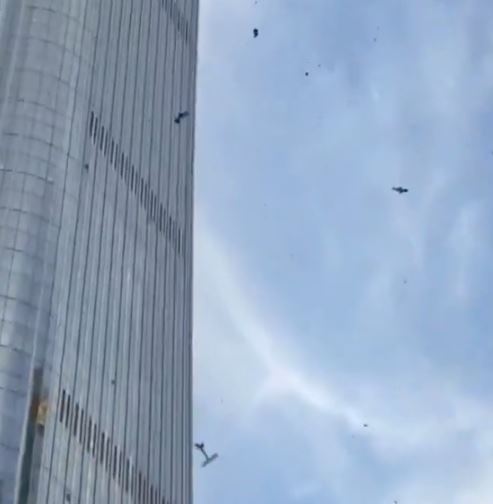
On the evening of Friday, June 26, 2026, a major emergency unfolded in Beijing’s central business district when a small, light-sport aircraft veered wildly off course and crashed into the upper floors of the CITIC Tower. Standing at an imposing 1,732 feet (528 meters) and 109 stories tall, the tower—familiarly known as China Zun due to its resemblance to an ancient Chinese wine vessel—is the capital's tallest skyscraper and a dominant fixture of its financial skyline. The impact occurred at approximately 6:00 PM local time, shattering multiple high-altitude glass panels and instantly triggering widespread panic in the dense corporate area below.
Witnesses on the street described hearing a deafening noise, with one courier recounting to reporters that the boom was "louder than fireworks." Almost immediately, dramatic videos and photos surfaced on social media showing large fragments of building materials, shards of glass, and pieces of the aircraft raining down onto the pavements and surrounding green spaces. Strikingly, the tail section of the aircraft—bearing partial registration marks—along with one of its wings, was filmed resting on the ground near the base of the tower, while a plume of thick smoke briefly rose from the high-altitude impact zone.
According to flight data compiled by platforms like Flightradar24, the aircraft was a domestically manufactured Sunward SA60L Aurora, a two-seat single-engine light-sport plane. It had taken off from Shifosi Airport, located roughly 50 kilometers east of the capital, for what was intended to be a routine flight operated by a local general aviation firm. However, about 30 minutes into the flight, the plane severely deviated from its expected flight path, headed westward, and directly breached the heavily fortified and strictly monitored airspace over downtown Beijing before losing its radar signal seconds before the crash.
The building was promptly evacuated as hundreds of corporate employees fled into the streets. Local authorities responded by mobilizing an immense security presence, deploying dozens of fire engines, ambulances, and police cars to cordon off adjacent roads and seal off the entire area. As of Friday night, no official statements regarding casualties or the precise condition of the pilot had been released, though preliminary reports suggested there were no mass casualties on the ground.
Compounding the unfolding crisis was a rapid and sweeping information suppression campaign. Operating any low-altitude aircraft or consumer drones in downtown Beijing is fiercely restricted under laws reinforced just months prior. Consequently, as images of the damaged skyscraper and plane wreckage spread, Chinese internet censors worked quickly to scrub videos from platforms like Weibo and Xiaohongshu. On-scene police officers were also observed actively instructing onlookers and journalists to delete any recorded media from their mobile phones. An official investigation into whether the flight deviation was caused by a catastrophic mechanical failure, a pilot medical emergency, or another factor is currently underway.




Facebook Comments